
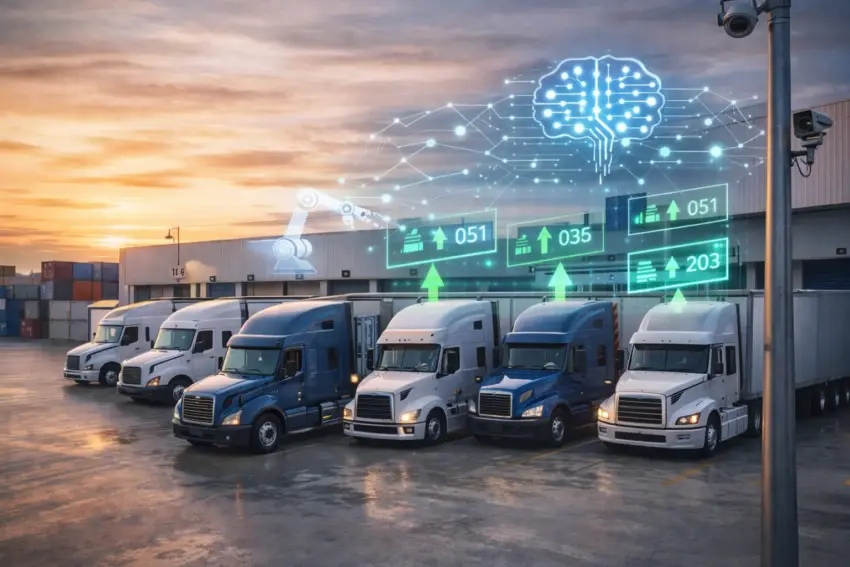
Major logistics hubs are deploying AI-based scheduling systems to cut truck idle time, targeting one of the biggest hidden costs in freight operations: vehicles waiting at gates, docks, and yards with engines running and drivers off the clock. Operators say the goal is to smooth arrivals and loading sequences, reduce congestion, and make better use of limited yard space—especially during peak delivery windows.
The new tools combine appointment booking, real-time yard visibility, and predictive modeling to recommend when trucks should arrive, where they should stage, and which dock should handle each load. Unlike static time slots, AI scheduling adapts to disruptions such as late inbound containers, equipment breakdowns, staffing gaps, and traffic delays.
Why idle time is a priority
Idle time creates a chain reaction across the supply network. When trucks queue for long periods, hubs face yard congestion, carriers lose productivity, and retailers receive late deliveries. The waste is not only financial: idling increases local emissions and noise, and long waits worsen driver satisfaction in a labor market where retention is already difficult.
How AI scheduling works at a hub
Most deployments bring together multiple data streams—booking requests, dock capacity, yard occupancy, loading status, and estimated times of arrival. The AI layer then proposes schedules that minimize conflict and keep docks continuously utilized without creating bottlenecks at the gate.
- Dynamic appointment slots that adjust as conditions change, rather than staying fixed all day.
- Queue prediction to flag when arrivals will exceed gate or yard capacity.
- Dock assignment optimization based on load type, handling needs, and available staff/equipment.
- Staging and yard routing to reduce unnecessary moves and deadheading inside the facility.
- Exception handling that prioritizes urgent loads and reorders tasks when disruptions occur.
What changes for carriers and drivers
For carriers, the most visible shift is tighter coordination. Drivers receive more precise arrival instructions, earlier warnings about delays, and clearer guidance on check-in and staging. Some hubs also provide live status updates so drivers do not arrive too early and join a queue that AI could have avoided.
In the best-case scenario, the system reduces “mystery waiting,” where drivers sit with no clear estimate of when they will be called. But the model can also introduce new friction if appointment rules are too strict or if carriers lack flexibility when traffic or loading schedules change.
“Idle time is not just a driver issue—it’s a network inefficiency. Scheduling intelligence only works if the whole site follows the same playbook.”
Operational benefits hubs are targeting
- Shorter gate queues by spreading arrivals more evenly across the day.
- Higher dock throughput by reducing gaps between loads and avoiding mismatches.
- Better labor planning with predicted workload peaks and staffing recommendations.
- Lower yard congestion through controlled staging and fewer internal moves.
- Cleaner compliance records with time-stamped events for disputes and performance reporting.
Risks and pushback
Logistics teams caution that AI scheduling is only as good as the data feeding it. Missing scans, inconsistent check-ins, and inaccurate ETAs can produce unreliable recommendations. There is also a governance challenge: if operators override the system frequently, or if different departments follow conflicting priorities, the model loses credibility.
Carriers may also worry about fairness—whether the system consistently favors certain partners, penalizes late arrivals too harshly, or shifts delay costs onto drivers. Many hubs are responding by adding transparency features such as visible queue logic, clearer penalty rules, and shared performance dashboards.
What happens next
As deployments mature, hubs are expected to connect AI scheduling more tightly with warehouse management systems, port or rail terminal updates, and real-time traffic feeds. The next step is often “closed-loop” control: not only predicting congestion, but automatically adjusting staffing, opening additional gates, or rerouting yard flows when threshold alerts are reached.
If the systems deliver measurable reductions in waiting time, the approach could become a standard requirement for high-volume logistics sites—especially where cities are pushing for lower local emissions and where supply chains demand tighter delivery windows.