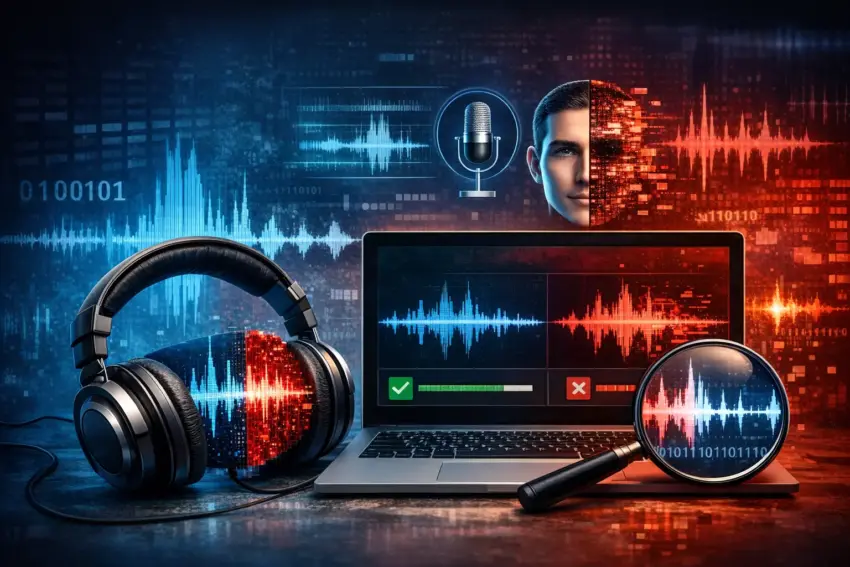
Researchers have released a new dataset aimed at benchmarking deepfake audio detection, providing a standardized resource for testing how well models can identify synthetic or manipulated speech. The dataset is intended to help close a persistent gap in the field: detection systems are often evaluated on different audio samples and conditions, making it difficult to compare results or understand how tools perform outside the lab.
Why a benchmark dataset matters
Deepfake audio is increasingly used in fraud and disinformation, including voice-cloning scams that target companies and families. Detection research moves quickly, but progress is hard to measure when teams use different training sets, different recording conditions, or different labeling standards. A shared benchmark can make comparisons more reliable and highlight where detection still breaks down.
- Comparable testing: consistent samples and labels across different detection tools.
- Realistic conditions: inclusion of noise, compression, and phone-quality audio where relevant.
- Generalization checks: measuring whether detectors work on unseen voices and models.
- Transparency: clearer reporting of what a model was tested on.
- Reproducibility: enabling researchers to repeat results and verify claims.
What the dataset includes
Benchmark datasets typically combine authentic recordings with a range of synthetic and manipulated variants. The goal is to capture different attack methods—from text-to-speech generation to voice conversion—while also reflecting everyday audio quality found in messaging apps, calls, and social media clips.
- Genuine speech samples recorded across different speakers and settings.
- Synthetic audio generated using multiple voice models and techniques.
- Voice conversion examples where a real speaker’s voice is transformed to sound like another.
- Degraded versions using compression, background noise, and re-recording artifacts.
- Standard labels and splits to support training, validation, and testing.
How it could help industry and law enforcement
A strong benchmark can accelerate practical defenses. Financial institutions, call centers, and identity verification providers increasingly need tools that can flag suspicious audio in real time. A public dataset can help vendors test their models against more diverse examples and quantify how detection performs when audio quality is poor or adversaries deliberately add distortion.
Limits and risks
Detection benchmarks also carry risks: if attackers know exactly what detectors are trained on, they may tune fakes to evade the most common tests. Researchers therefore emphasize the importance of continual updates and “out-of-distribution” evaluation—testing against unseen generation methods and novel manipulation patterns.
Another challenge is representativeness. If a dataset does not include enough linguistic diversity, accents, or recording environments, detectors may perform well on benchmark tests but fail in real-world settings. That is especially relevant in multilingual contexts across Europe.
What to watch next
Researchers and platform security teams are expected to use the dataset to establish stronger baselines and publish more comparable results. Over time, the most useful benchmarks tend to evolve into “living” datasets with periodic updates, new attack types, and clearer reporting standards for performance under real-world conditions.
Bottom line
A standardized dataset for deepfake audio detection can make research more comparable and help translate academic work into practical tools. The key measure of success will be whether it improves detection in messy real-life audio—calls, messaging apps, and noisy recordings—where deepfake scams are most likely to be deployed.