
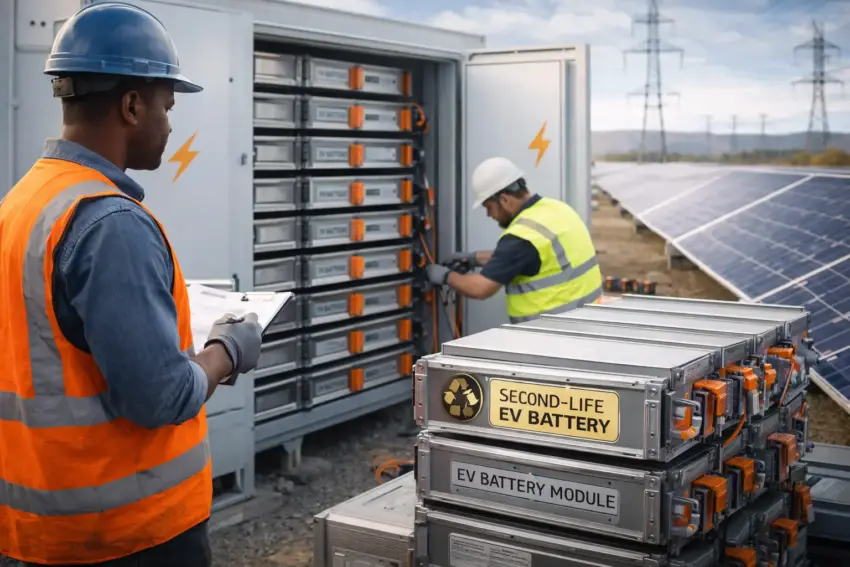
Energy startups are expanding grid storage projects using second-life EV batteries, repurposing used battery packs from electric vehicles to store electricity for buildings, charging hubs, and local grids. The approach aims to cut costs and reduce waste by extending battery life beyond the car—often for years—before materials are ultimately recycled.
What “second-life” batteries are
When an EV battery no longer meets the performance needs of a vehicle, it can still retain significant capacity for stationary use. In cars, reduced range and peak power can be a problem. In grid storage, where weight and acceleration do not matter, batteries can operate under gentler conditions and deliver value in slower, more predictable cycles.
- Repurposed EV packs removed from vehicles after years of driving.
- Stationary use in containers or cabinets instead of inside a car.
- Lower performance requirements compared with automotive applications.
- Extended lifetime before final recycling and material recovery.
- Cost advantage versus buying new battery cells for some projects.
Why startups are building more projects now
As EV sales rise, more battery packs are reaching a stage where they can be refurbished, tested, and redeployed. At the same time, grids need flexible storage to manage renewable generation and peak demand. Startups see a commercial opportunity: second-life systems can provide backup power, reduce electricity bills through peak shaving, and support solar self-consumption—often with a lower upfront cost than new batteries.
Where second-life storage is being used
Projects tend to focus on locations where predictable cycling and local resilience matter. Many systems are deployed behind the meter—on the customer side—where they can deliver savings and grid services without requiring large utility-scale land and permitting processes.
- Commercial buildings reducing peak demand charges and smoothing load.
- EV charging sites supporting fast charging without expensive grid upgrades.
- Solar-plus-storage projects that store daytime generation for evening use.
- Microgrids for campuses, logistics centers, and industrial parks.
- Community backup for critical sites such as shelters and local services.
Challenges: testing, safety, and standardization
Second-life batteries are not identical. Packs vary by model, chemistry, age, and past usage, which complicates certification and performance guarantees. Startups must test cells, manage uneven degradation, and build control systems that can operate safely. Fire safety, thermal management, and clear responsibility across the supply chain are central concerns—especially when batteries originate from multiple vehicle sources.
- Quality screening to identify usable packs and detect damaged modules.
- Safety engineering including thermal management and fire containment design.
- Warranty questions around lifespan and performance guarantees.
- Regulatory compliance for transport, installation, and operation.
- Data access to battery history, which improves sorting and predictive maintenance.
What it could mean for Germany’s energy transition
In Germany, distributed storage is increasingly seen as a tool for integrating renewables and stabilizing local grids. Second-life systems could accelerate deployment by lowering costs and improving material efficiency. They may also support resilience for businesses and municipalities facing grid constraints—particularly as EV charging demand grows.
What to watch next
The next developments will likely focus on standardization and scale: more consistent testing protocols, clearer certification pathways, and stronger integration with recycling pipelines. Startups will also face a moving target: as new EV batteries improve and recycling becomes more efficient, the cost advantage of second-life systems will depend on supply, logistics, and regulatory incentives.
Bottom line
Second-life EV batteries are emerging as a practical building block for grid storage, offering a way to extend battery value and support renewable-heavy power systems. If startups can manage safety, quality variation, and warranty confidence, repurposed packs could become a significant source of flexible storage—especially for charging hubs and behind-the-meter projects.