
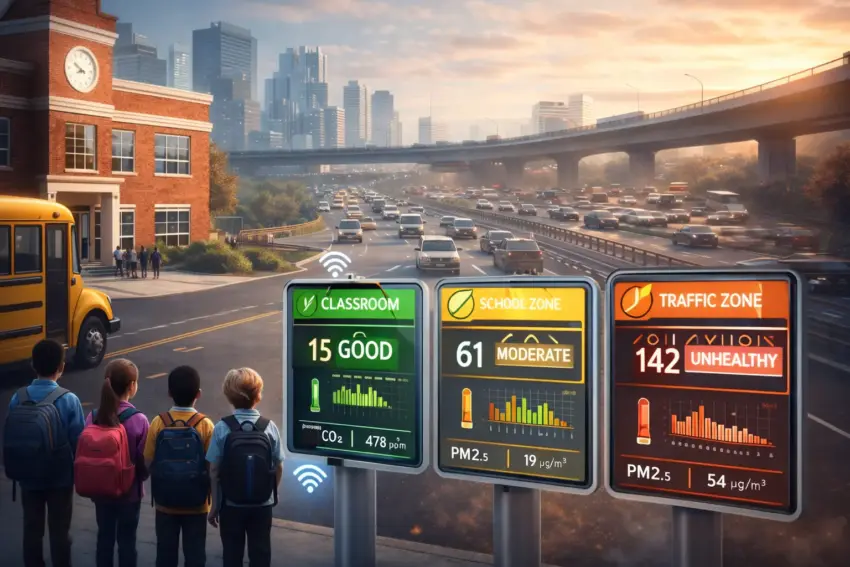
Several municipalities are rolling out air quality dashboards for schools in high-traffic districts, giving administrators, parents, and teachers near real-time insight into pollution levels around school buildings. The dashboards are designed to make invisible risks more visible, particularly during rush hours when vehicle emissions and congestion can drive short-term spikes in nitrogen dioxide and fine particulate matter.
Officials say the goal is practical decision support rather than abstract data. Schools can use the dashboards to adjust outdoor activities, time ventilation, and communicate with families during unusually poor air days—while cities use the aggregated data to identify hotspots and evaluate traffic or street-design interventions.
What the dashboards typically show
Most school-focused dashboards are built to be readable on mobile and understandable without technical training. Common elements include:
- Current air quality indicators (often PM2.5, PM10, and NO₂), shown with simple risk bands.
- Hourly trends to highlight morning drop-off and afternoon pickup peaks.
- Short-term forecasts when available, to support planning for sports and outdoor lessons.
- Weather context such as wind and temperature, which can affect pollutant dispersion.
- Health guidance tailored for children, including suggested actions during high readings.
Some systems also flag “exception days” such as nearby roadworks, temperature inversions, or wildfire smoke events that can worsen local air conditions.
Why high-traffic school zones are a priority
Schools near major roads or dense urban corridors often experience sharp exposure peaks at specific times of day. Even when citywide averages look acceptable, localized street canyons and congestion can create conditions that are worse right outside school entrances. Public health experts note that children are more vulnerable to air pollution because they breathe more air per body weight and spend time outdoors during breaks and sports.
How schools are using the information
Education administrators describe a range of low-cost actions informed by dashboards:
- Scheduling outdoor activities for cleaner windows of the day.
- Ventilation timing to reduce bringing polluted air indoors during peak traffic.
- Pick-up and drop-off management to discourage idling near entrances.
- Targeted communication to parents when readings are elevated for extended periods.
In some schools, the dashboard is displayed in common areas as an awareness tool, helping students connect traffic patterns with environmental effects and supporting classroom lessons on health and sustainability.
“The point is not to alarm families—it’s to give schools a simple, shared signal for when small adjustments can reduce exposure.”
Questions about sensors and accuracy
Experts caution that sensor placement and calibration matter. Low-cost monitors can be useful for trends and peaks, but readings can vary based on distance from the road, height, and local airflow. Cities launching dashboards say they are combining fixed reference stations with additional neighborhood sensors and using validation checks to reduce false spikes and gaps.
What comes next
Municipalities expect the next phase to include more schools, clearer alert thresholds, and integration with broader measures such as school street closures at peak hours, anti-idling enforcement, and greening projects. If the dashboards prove useful, they could become a standard tool for managing the daily reality of air quality in traffic-heavy districts—turning environmental monitoring into an actionable part of school operations.