
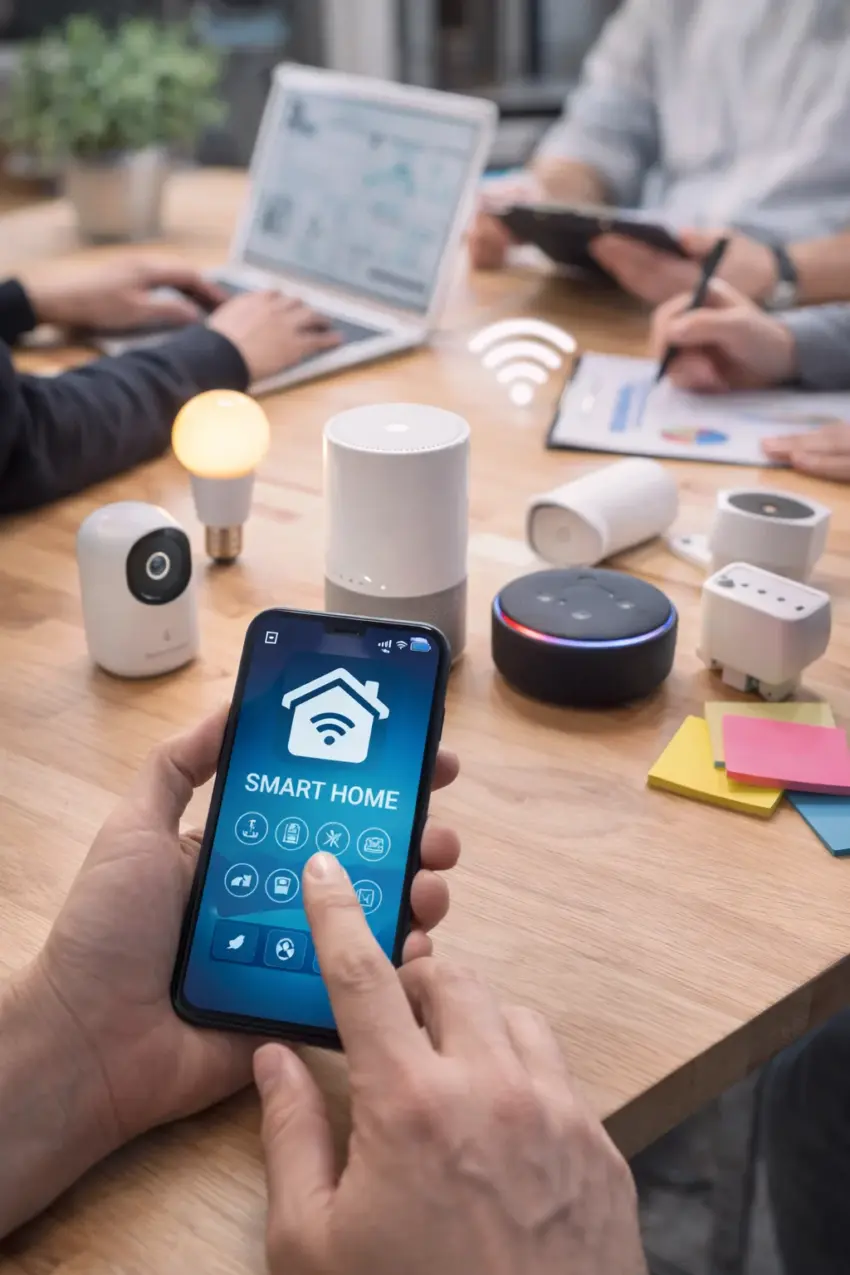
Smart home brands are agreeing on shared interoperability testing for new device launches, aiming to reduce the “works in one app but not another” problem that still frustrates consumers. The push centers on aligning test methods and certification pathways so devices behave consistently across ecosystems—especially as more products ship with Matter support and are expected to work with multiple controllers out of the box.
Industry groups and participating companies are framing the effort as a reliability upgrade rather than a marketing label. The idea is that devices should not only meet a specification on paper, but also pass repeatable, real-world interoperability checks before they reach retail shelves.
What “interoperability tests” actually cover
Interoperability testing focuses on whether devices can be commissioned, controlled, and remain stable across different hubs and apps. Programs typically validate:
- Commissioning and setup (pairing flows, QR/NFC onboarding, error handling).
- Core device functions (on/off, dimming, sensing, locks, and other category-specific behaviors).
- Network performance across Thread and Wi-Fi environments, including reconnection behavior.
- Security and encryption requirements used during onboarding and device communication.
- Controller compatibility so the same product behaves predictably across major smart home platforms.
To support consistent results, standardized test tooling and a common test harness are increasingly used so vendors can run comparable checks during development and before formal certification.
Why the industry is standardizing testing now
Smart home adoption has expanded beyond enthusiasts, and brands are under pressure to reduce returns and support tickets caused by pairing failures, unreliable automations, or partial feature support. Matter was designed to improve cross-brand compatibility, but real-world reliability still depends on how consistently vendors implement features and how well devices behave under mixed-network conditions.
Standard interoperability testing is also a response to faster product cycles. Many companies want to release new device variants without repeating lengthy certification processes from scratch, which has driven interest in streamlined certification models and shared lab results.
How certification programs are evolving
The Connectivity Standards Alliance has been expanding certification options and emphasizing interoperability infrastructure, including its Alliance Interop Lab and newer certification programs intended to reduce time and duplication for vendors shipping multiple similar products.
Another recent focus is certifying underlying development platforms. “Matter Compliant Platform” certification is meant to validate defined hardware-and-software combinations from silicon and platform vendors, so device makers can build on pre-validated foundations rather than re-proving the same core functions repeatedly.
What this could change for consumers
If interoperability tests become more consistent and widely adopted, shoppers may see fewer setup failures and fewer “missing feature” surprises after firmware updates. The biggest improvements are expected in:
- More reliable onboarding for multi-device packs and hard-to-reach QR codes.
- Fewer ecosystem lock-ins as devices behave more predictably across controllers.
- More stable automations when networks restart, routers change, or power is interrupted.
- Clearer expectations about which features are supported across platforms.
Recent Matter updates have also targeted setup and usability improvements, reinforcing the industry direction toward fewer friction points in everyday installations.
What remains difficult
Even with shared tests, challenges remain. Device makers still need to handle edge cases such as crowded Wi-Fi, mixed Thread networks, and inconsistent router behavior. Differences in how platforms expose features can also lead to uneven experiences—where a device technically works everywhere but offers richer controls in one ecosystem than another.
There is also a practical scaling issue: as new device categories and standards evolve, test suites must keep up without becoming so heavy that they slow innovation. Industry groups are therefore trying to balance strictness (to ensure reliability) with speed (to avoid blocking product cycles).
What happens next
Expect more brands to emphasize interoperability readiness in launch messaging, with greater reliance on shared test tooling, lab-based validation, and platform-level certification. For consumers, the real measure will be visible: fewer failed pairings, fewer unpredictable updates, and smart home devices that behave the same way regardless of which major app or hub is used to control them.