
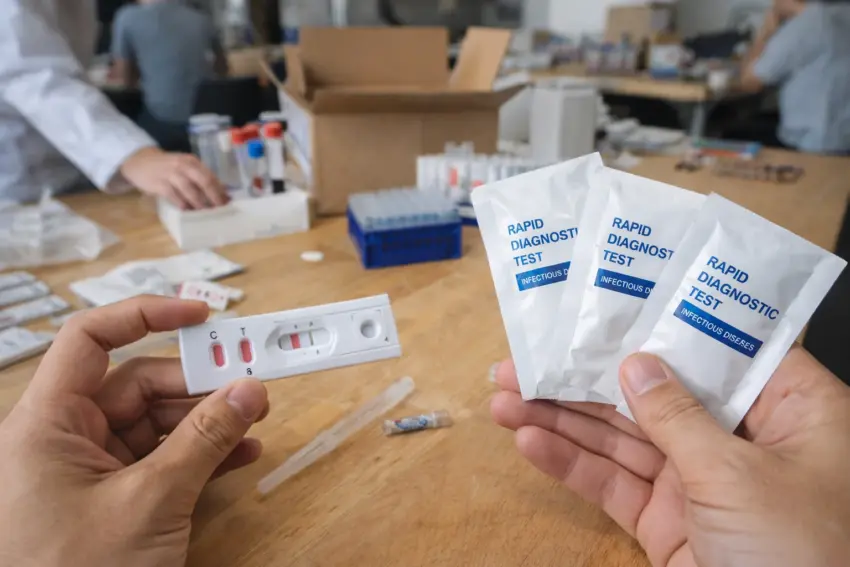
Biotech research teams are reporting early progress toward lower-cost rapid diagnostic kits that can deliver reliable results outside traditional laboratories. The latest work focuses on simplifying sample preparation, reducing reagent use, and improving readouts so tests can be deployed in clinics, pharmacies, and low-resource settings without complex equipment.
Alongside technical advances, researchers and global health agencies are highlighting a second bottleneck: usability. Even “low-cost, fast” tests can fail in real-world settings if instructions, fonts, symbols, or handling steps are not designed for practical use by a wide range of users.
What “low-cost rapid diagnostics” are aiming to deliver
Most next-generation rapid kits target a small set of performance goals: short time-to-result, minimal hands-on steps, low per-test cost, and dependable sensitivity and specificity. Research reviews in point-of-care diagnostics note that the strongest candidates combine simplified workflows with clinical validation pathways and clear oversight rules for safe deployment.
Where researchers report the biggest efficiency gains
Early results point to improvements in three parts of the diagnostic pipeline: the test “platform,” the chemistry, and the readout.
- Paper-based microfluidics: New designs aim to integrate multiple steps (sample handling, amplification, and detection) on low-cost paper chips, while addressing known challenges such as extraction efficiency and readout standardization.
- Isothermal amplification: Instead of lab PCR machines, many kits use amplification methods that work at a single temperature, enabling smaller, cheaper devices or instrument-free workflows.
- CRISPR-based detection: Research continues to improve sensitivity and operational convenience for CRISPR diagnostics, with emphasis on assay simplification and suitability for point-of-care use.
Why “early results” often look promising but are hard to compare
Teams often report different endpoints: some highlight analytical sensitivity in controlled samples, others emphasize time-to-result, and others focus on cost or manufacturability. Reviews of point-of-care innovation repeatedly stress that moving from prototype to scalable product depends on robust validation, stable performance across diverse sample types, and clear quality controls.
Usability is becoming a core performance requirement
As tests move closer to self-testing and community use, accessibility and human factors are becoming as important as chemistry. WHO guidance highlights that barriers such as difficult-to-read labels, confusing symbols, and handling complexity can prevent people from using rapid tests effectively—even when they are accurate and inexpensive.
For low-cost rapid diagnostics, “works in the lab” is no longer enough; designs must also work reliably in real environments with minimal training.
What happens next
Researchers say the next milestone is repeatable, real-world performance: longer pilot studies, tougher testing in varied settings, and manufacturing plans that keep costs low without sacrificing quality. As global demand for decentralized diagnostics grows, the strongest contenders are expected to be those that pair technical efficiency with standardized readouts, clear instructions, and credible validation—so rapid kits can scale beyond demonstrations into routine care.