
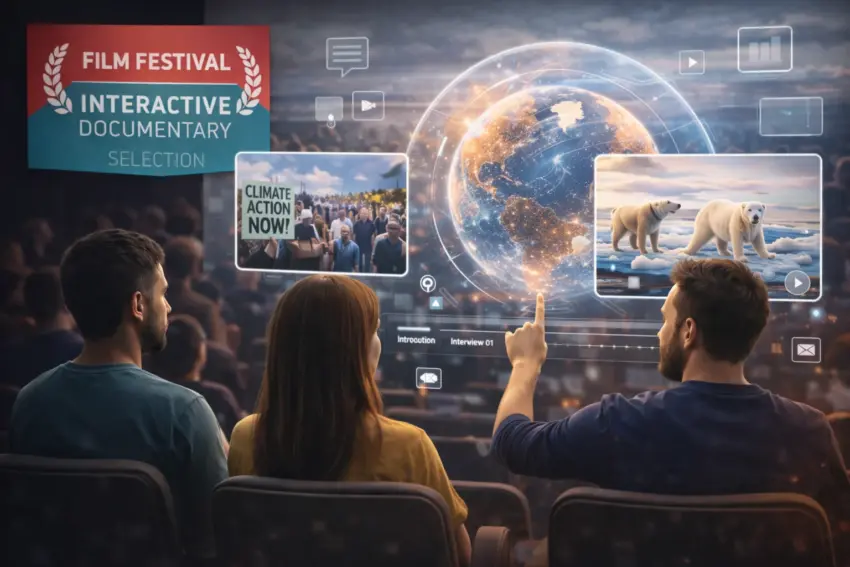
Film festivals are creating new categories for interactive documentary projects, reflecting a growing shift in nonfiction storytelling toward formats that blend cinema, games, and digital experiences. Festival organizers say the move is meant to recognize work that cannot be judged by traditional documentary criteria alone, because the “viewing” experience depends on user choices, navigation, or participation.
The new categories appear in festival sidebars and innovation sections, often alongside VR, AR, and immersive media. But interactive documentary is increasingly being treated as its own field—distinct from both classic film and purely experimental installations—because many projects combine investigative reporting, archival material, and real-world testimony with interactive design.
What counts as an interactive documentary
Interactive documentaries are nonfiction works where the audience influences how the story unfolds or what information is explored. Instead of a single linear cut, the project can offer multiple paths through interviews, data, locations, or timelines.
- Web-based documentaries that allow users to explore scenes, documents, or story chapters in different orders.
- Immersive projects using VR or AR to place viewers inside reconstructed environments or guided experiences.
- Interactive installations that respond to movement, choices, or collective participation in a festival space.
- Data-driven narratives that let audiences filter and compare evidence, maps, or testimonies.
Creators argue that the format can deepen engagement by turning viewers into active participants—especially when the subject involves complex systems, contested histories, or lived experiences that benefit from exploration rather than a single authorial route.
Why festivals are adding dedicated categories
Festival programmers say interactive nonfiction has outgrown the “new media” label. Many projects now have production teams similar in scale to documentary films, including journalists, filmmakers, designers, developers, sound artists, and researchers. Dedicated categories help festivals evaluate these works on their own terms and provide clearer routes for selection, awards, and funding visibility.
Another factor is audience behavior. Younger festivalgoers are increasingly comfortable with hybrid formats—watching a film, then exploring related materials, or engaging with a story through interactive elements rather than a fixed runtime. Festivals see interactive documentary as a way to broaden attendance and connect nonfiction storytelling to contemporary digital culture.
How judging criteria are changing
Creating a category is also a signal that evaluation standards are evolving. Instead of focusing only on cinematography, editing rhythm, and linear narrative arc, juries may consider:
- Editorial integrity and how clearly sources, claims, and context are presented.
- Interaction design, including whether choices feel meaningful rather than decorative.
- Accessibility across devices and for audiences with different needs.
- Ethics of participation, especially when users can influence how testimonies or sensitive materials are revealed.
- Technical stability and long-term usability beyond the festival premiere.
Programmers note that a brilliant story can be undermined by poor navigation or confusing interaction, while a technically impressive experience may fall short if the documentary purpose is unclear.
Opportunities for documentary makers
For creators, the new category structure can open doors to new partners and budgets. Interactive projects often attract support from cultural funds, innovation labs, public broadcasters, universities, and digital arts institutions. Festivals can also provide a rare testing ground where creators watch audiences engage with the work and improve it through feedback.
“A linear documentary asks viewers to follow. An interactive documentary asks viewers to explore—and that changes how you build trust, pacing, and emotional impact.”
Challenges: preservation, access, and scale
Interactive documentaries face hurdles that traditional films do not. Web technologies change quickly, VR hardware becomes outdated, and platform rules can affect distribution. Festivals and makers are increasingly discussing preservation strategies—how to keep projects accessible years later and how to archive interactive works in ways that remain functional.
There is also the question of reach. Some interactive projects require festival installations or specific headsets, which can limit audiences. To address this, creators are experimenting with multi-format releases: an installation for festivals, a web version for broader access, and short video components for social sharing.
What comes next
Festival organizers expect interactive documentary categories to expand and become more structured, with clearer submission requirements and stronger technical support on-site. As nonfiction storytelling continues to merge with digital design, the distinction between documentary film, immersive media, and interactive journalism is likely to blur further—while festivals increasingly act as a bridge between these worlds.