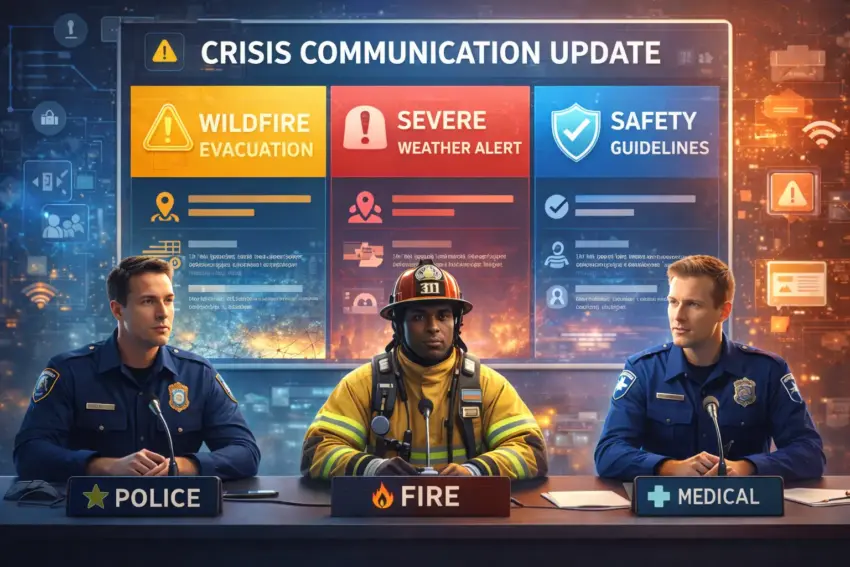
Public agencies are adopting a shared template for crisis communication updates, aiming to make official messages faster to publish, easier to understand, and more consistent across channels during emergencies. The approach standardizes what information is included in each update—such as what happened, what residents should do next, and where to find verified details—reducing confusion when multiple departments publish in parallel.
Why agencies are standardizing crisis updates
During floods, storms, wildfires, cyber incidents, and public safety disruptions, people often receive fragmented information from different authorities. A shared template helps agencies publish clear, repeatable updates under time pressure, while also improving accessibility for residents who rely on quick scanning rather than long statements.
- Speed: prebuilt structure reduces drafting time during fast-moving events.
- Clarity: consistent headings make key actions easy to find.
- Trust: standardized phrasing reduces rumors and contradictory messaging.
- Multi-channel use: the same content can be adapted for web, apps, SMS, and social platforms.
- Operational coordination: agencies can align on who communicates what, and when.
What the shared template typically includes
While formats vary, the shared template model usually follows a short, action-first structure. The goal is to provide essential information in a predictable order, so residents do not need to re-learn how to read updates during each new crisis.
- Headline summary describing the situation in one sentence.
- Time stamp showing when the update was issued and when it will be refreshed.
- What is happening with verified facts and affected areas.
- What you should do now with clear, practical instructions.
- What services are affected such as transport, schools, utilities, or healthcare access.
- Where to get verified information including official hotlines and websites.
- Next update schedule to reduce repeated calls and speculation.
How it changes communication during emergencies
Officials say templates reduce the risk of overlong statements that bury the most important action steps. They also help agencies coordinate: police, fire services, transport authorities, and local governments can publish aligned updates using a shared structure, while still providing department-specific details.
Another benefit is translation readiness. A consistent template can be easier to translate quickly into multiple languages, improving access for diverse communities.
What it could mean in Germany
In Germany, shared templates could improve how information is distributed during regional floods, severe storms, and infrastructure disruptions, particularly when updates come from multiple administrative levels. Clear, standardized messaging can also support warning apps and local websites, where residents expect concise, actionable guidance.
Challenges: keeping templates flexible
Standardization can backfire if templates become rigid. Agencies must still adapt to the specific crisis—especially when details are uncertain or evolving. Communication specialists also warn that templates should not be used to mask uncertainty; instead, they should clearly label what is confirmed, what is being investigated, and what residents should do while waiting for more information.
What to watch next
Next steps are likely to include integration with publishing tools, so agencies can generate consistent web posts, push notifications, and social updates from one source. Some jurisdictions may also develop shared icon sets and risk-level labeling to make updates easier to scan. Over time, agencies may publish after-action reports measuring whether standardized updates reduced misinformation and improved compliance with safety guidance.
Bottom line
A shared template for crisis communication is an effort to make emergency updates more actionable and less confusing. If agencies balance consistency with transparency about uncertainty, the approach can improve public trust and help residents respond faster—especially when multiple authorities must communicate at once.